


I
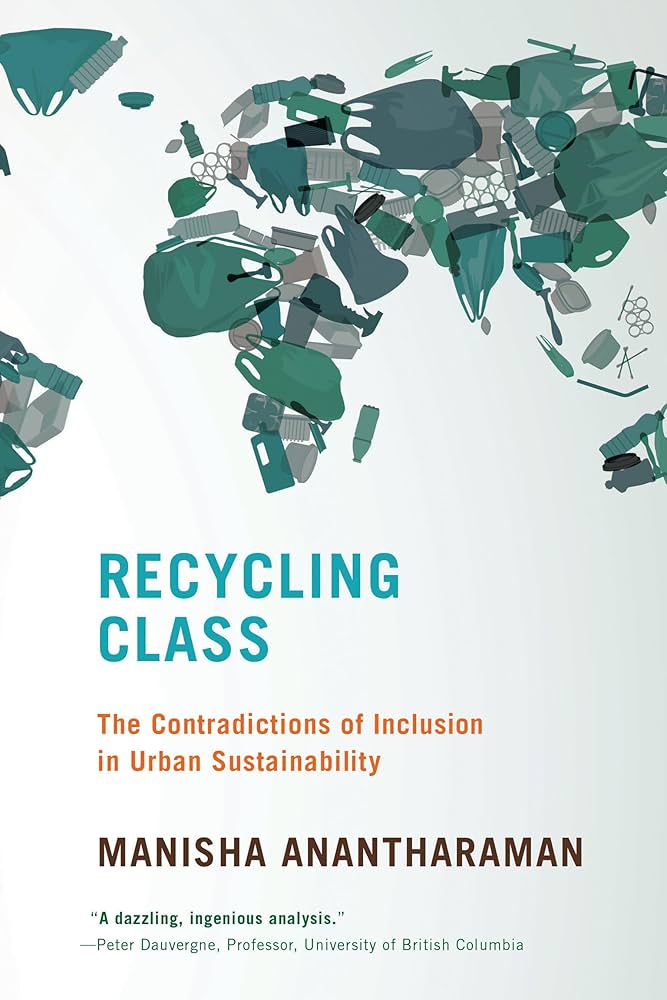
n the mid-1990’s I was doing field work for my dissertation in some of the city of Chicago’s most impoverished and environmentally burdened communities. What inspired me most about the advocacy among environmental leaders was the daily work that grassroots recycling organizations were performing, in collaboration with middle-class residents who paid a subscription fee to have their waste collected and diverted from the landfills and incinerators that were overwhelmingly and unjustly located in socially marginalized communities. I found myself grasping for ways to make sense of these dynamics and eventually muddled my way through, but after reading Manisha Ananatharaman’s Recycling Class, I now have the conceptual tools to better understand what I was observing those many years ago. Ananatharaman’s book is groundbreaking scholarship and a true pleasure to read.
Anantharaman’s critique of what she calls performative environmentalism is refreshing because she doesn’t take for granted the claims of middle-class environmentalists, but she also doesn’t dismiss their motivations or sincerity in their quest for meaningful, sustainable lifestyles. She examines the full range of their embrace of “green” lifestyles, which requires a critical analysis of the ways in which that lifestyle requires the labor of Dalits and other subjugated populations to produce the infrastructures that make middle class sustainable living possible. Ultimately, therefore, performative environmentalism is a handmaiden to the violence of neoliberalism, and seeks to address environmental and climate challenges via recycling, retrofits, gardening, biking, and feel-good educational campaigns and consumption. Underlying and reinforcing these dynamics is environmental casteism, which deliberately restricts discourses, privileges and practices of cleanliness and green behaviors to the middle and upper echelons of India’s caste system, while blaming and stigmatizing lower castes, Dalits, Scheduled Castes, Scheduled Tribes, and non-Hindus for the pollution and waste they have been forced to work and live with. Environmental casteism parallels the scourge of environmental racism found in other contexts, and cements environmental privileges for a minority, all the while attempting to naturalize those distinctions.
Anantharaman’s analysis of how the Indian state and the municipality of Bengaluru’s “clean and green” program requires gendered labor is insightful. The author demonstrates how gender, class and caste intersect as lower class/caste women, servants, maids, mothers, housekeepers, and retirees are tasked with the daily reproductive labor of making sustainability possible in the domestic sphere, in their neighborhoods, and at the municipal scale—recycling, sorting, and reusing waste, cooking more sustainably, and leading educational campaigns all for little or no remuneration or recognition, and yet serving as indispensable elements for the greening of capitalism. And they have been surprisingly successful, winning legal and policy victories that result in government and court rulings to mandate the development of waste recovery centers, for example, in Bengaluru, and a state-wide ban on the production, distribution, storing and consumption of single-use plastics in Karnataka. The waste picker-led group, Parisara Tanda (“green force”) recognized the limitations of performative environmentalism and effectively used the language of neoliberalism to reframe the value of waste pickers as entrepreneurial environmentalists rather than as essential workers. Their strategy was to issue demands for a friendly regulatory environment and startup capital for individual waste pickers rather than better wages and working conditions for their sector as a whole (the latter being a goal that a traditional labor rights framing would have articulated). As Ananatharaman points out, this inclusionary strategy was effective at securing key gains that resulted in decriminalization and recognition, but it also left major deficits, such as leaving the caste and class structures intact and eschewing a mode of collective identity and organizing.
Importantly, Anantharaman demonstrates how and why ethnographic methods are critical to locating and understanding the complex and nuanced layers of power and possibility in these communities. For example, her close reading of the dynamics within the DIY infrastructure of the Dry Waste Collection Center in Bengaluru reveals how indeed, this labor by middle-class women and waste pickers positions them as a form of social infrastructure taking on what were previously functions performed by the state in order to keep the city clean and green. Ananatharaman’s ethnographic eye reveals that while those stakeholders were assuming those additional burdens in a neoliberal state, that labor also provided them with access to venues and spaces that facilitated the amplification of their voices and perspectives. Specifically, the cross-class collaborations of waste pickers and middle-class women environmentalists produced state recognition of the former group’s value to the city’s environmental and economic goals. Ananatharaman contends that the zones of contact wherein middle-class Indians and waste pickers interact and realize their mutual interests (and the author provides moving examples of such encounters and revelations) are critical spaces that provide possibilities of cross-class solidarity that will be necessary to stem the tide of the most harmful dimensions of neoliberalism in the nation. I agree, but there is a built-in contradiction here that requires the hierarchy between these groups to be sustained in order for such coalitions to exist and endure. Anantharaman clearly understands that contradiction and takes direct aim at it by arguing that, at the end of the day, ecological sustainability, just sustainability and any form of environmental or social justice in India will only be realized if the caste system is annihilated. I am excited about her decision to use the term annihilation, but I also wondered why this term versus another, such as abolition? I imagine one could argue that while enslavement has been legally abolished in most parts of the world, it has certainly not been annihilated, so that choice of framing makes sense to me, but I’d like to know more from the author regarding her thinking about these terms. Relatedly, I see a clear opportunity to build on the author’s observations of the parallels between environmental racism and casteism and the struggle for racial justice in other parts of the world, so it would be useful to learn more about how she sees relationships and tensions between movements for the abolition of incarceration and neo-slavery in the U.S. and elsewhere with the idea of caste annihilation in India. Relatedly, what would the annihilation of the caste system look like and are there precedents or examples that we could draw and learn from toward that end? In my view this idea reads more like a provocation than a fully fleshed out conceptual framework, so I look forward to further learning on this matter.
Ananatharaman refers to the Indian national hierarchy as a “broken system,” while I would imagine that many activists might conclude that a more accurate characterization would be to call it an unjust system because for that nation’s elites, the system appears to be working more or less just fine. Ananatharaman might respond that the system is broken insofar as the plight of the waste pickers reveals how their vulnerability and wellbeing is intimately linked to the vulnerability and wellbeing of the middle classes, but I would argue that is always the case in any system of hierarchy, by design, because hierarchies are always systems of mutual precarity.
And that brings us to Ananatharaman’s final conceptual intervention: reparation by inclusion. This concept reflects her conclusion that since informal economies have always subsidized formal economies (which is certainly true), reparations would entail deeper investments in support of the informal sector and its laborers in a way that recognizes historic and ongoing injustices and rejects the dehumanization of informal workers. While I find this idea appealing for many reasons, I also wonder, as I noted earlier, if the system isn’t actually broken but instead working as it was intended, then is inclusion into that system—even with meaningful and well-intentioned reforms—actually a good idea? I’m reminded of the work of Ethnic Studies and Indigenous Studies scholars who have argued that inclusion and its cousin, assimilation, can serve as forms of cultural erasure and give life to new methods of differentiation and hierarchy that make it difficult to achieve transformative change. I would like to see the author define reparations more clearly and consider connecting this concept to reparations movements and scholarship from other parts of the world. I also believe this discussion signals an inherent and productive tension between inclusion and annihilation. I imagine one could make a sequential argument that once we have annihilated the caste system, inclusion makes perfect sense, or perhaps that inclusion will facilitate annihilation of the (pre)existing system, but I think that needs to be spelled out a bit more. And there is perhaps some confusion around the author’s intentions here, given the chapter title (“Beyond Inclusion, Toward Reparation”), the author’s concept of reparation by inclusion, and the fact that in many ways, reparation is, by its very nature, an inclusionary project.
I would like to close on a slightly different register. As much as I appreciated the host of new concepts introduced in this book, I also found myself feeling a little overwhelmed by their sheer volume. That’s not a bad thing, especially if each concept offers its own contribution and, collectively, they add up to more than the sum of their parts, which is most certainly true in this case. It’s just a bit of a challenge to keep up with all of them. This is where I would encourage readers—and especially teachers using this book in their courses—to consider an exercise where you invite your students to crowd source some or all of these concepts as “key words” that you can write on a screen or blackboard in order to collectively define each of them and discuss how they are interrelated, and how they apply to your students’ lives. That would be another enriching and exciting way to engage with this important work.
Recycling Class is a wonderful addition to the literature, featuring scholarship, analysis, methodological techniques and theoretical interventions of the highest quality, all of which will be top of mind the next time I visit my former field research sites in Chicago.
David N. Pellow is the Dehlsen Chair and Distinguished Professor of Environmental Studies at the University of California, Santa Barbara. His teaching, research, and activism focus on environmental justice in the U.S. and globally. His books include: What is Critical Environmental Justice?


