S
cholars and practitioners of urban planning need to rethink the field’s futures at this important historical juncture: some might call it a moment of truth when there is little left to hide. The COVID-19 pandemic exposed many cracks, contradictions, and inequalities that have always existed but are now more visible. This also includes the global vaccine apartheid that is ongoing as I write these words. Moreover, this is a time when the violence through which U.S. imperialism has exercised power worldwide is increasingly exposed. Protests in the summer of 2020, which spread all over the United States like fire through a long-dried haystack, showed Americans and the whole world that racialized violence and police brutality are real. They also revealed that such brutality is spatially facilitated in American apartheid—a condition that planning has been far from innocent in creating and maintaining. I think this reckoning is particularly important in the United States, the belly of the beast, where there might have been more of an illusion about planning innocence.
What’s a Rich Text element?
Moreover, this is a time when the violence through which U.S. imperialism has exercised power worldwide is increasingly exposed. Protests in the summer of 2020, which spread all over the United States like fire through a long-dried haystack, showed Americans and the whole world that racialized violence and police brutality are real. They also revealed that such brutality is spatially facilitated in American apartheid—a condition that planning has been far from innocent in creating and maintaining. I think this reckoning is particularly important in the United States, the belly of the beast, where there might have been more of an illusion about planning innocence.
- Moreover, this is a time when the violence through which U.S. imperialism has exercised power worldwide is increasingly exposed.
- Protests in the summer of 2020, which spread all over the United States like fire through a long-dried haystack, showed Americans and the whole world that racialized violence and police brutality are real.
- They also revealed that such brutality is spatially facilitated in American apartheid—a condition that planning has been far from innocent in creating and maintaining.
- I think this reckoning is particularly important in the United States, the belly of the beast, where there might have been more of an illusion about planning innocence.
What’s a Rich Text element?
Moreover, this is a time when the violence through which U.S. imperialism has exercised power worldwide is increasingly exposed. Protests in the summer of 2020, which spread all over the United States like fire through a long-dried haystack, showed Americans and the whole world that racialized violence and police brutality are real. They also revealed that such brutality is spatially facilitated in American apartheid—a condition that planning has been far from innocent in creating and maintaining. I think this reckoning is particularly important in the United States, the belly of the beast, where there might have been more of an illusion about planning innocence.
- Moreover, this is a time when the violence through which U.S. imperialism has exercised power worldwide is increasingly exposed.
- Protests in the summer of 2020, which spread all over the United States like fire through a long-dried haystack, showed Americans and the whole world that racialized violence and police brutality are real.
- They also revealed that such brutality is spatially facilitated in American apartheid—a condition that planning has been far from innocent in creating and maintaining. I think this reckoning is particularly important in the United States, the belly of the beast, where there might have been more of an illusion about planning innocence.
What’s a Rich Text element?
Moreover, this is a time when the violence through which U.S. imperialism has exercised power worldwide is increasingly exposed. Protests in the summer of 2020, which spread all over the United States like fire through a long-dried haystack, showed Americans and the whole world that racialized violence and police brutality are real. They also revealed that such brutality is spatially facilitated in American apartheid—a condition that planning has been far from innocent in creating and maintaining. I think this reckoning is particularly important in the United States, the belly of the beast, where there might have been more of an illusion about planning innocence.
What’s a Rich Text element?
Moreover, this is a time when the violence through which U.S. imperialism has exercised power worldwide is increasingly exposed. Protests in the summer of 2020, which spread all over the United States like fire through a long-dried haystack, showed Americans and the whole world that racialized violence and police brutality are real. They also revealed that such brutality is spatially facilitated in American apartheid—a condition that planning has been far from innocent in creating and maintaining. I think this reckoning is particularly important in the United States, the belly of the beast, where there might have been more of an illusion about planning innocence.
What’s a Rich Text element?
Static and dynamic content editing
A rich text element can be used with static or dynamic content. For static content, just drop it into any page and begin editing. For dynamic content, add a rich text field to any collection and then connect a rich text element to that field in the settings panel. Voila!
How to customize formatting for each rich text
Headings, paragraphs, blockquotes, figures, images, and figure captions can all be styled after a class is added to the rich text element using the "When inside of" nested selector system.
F
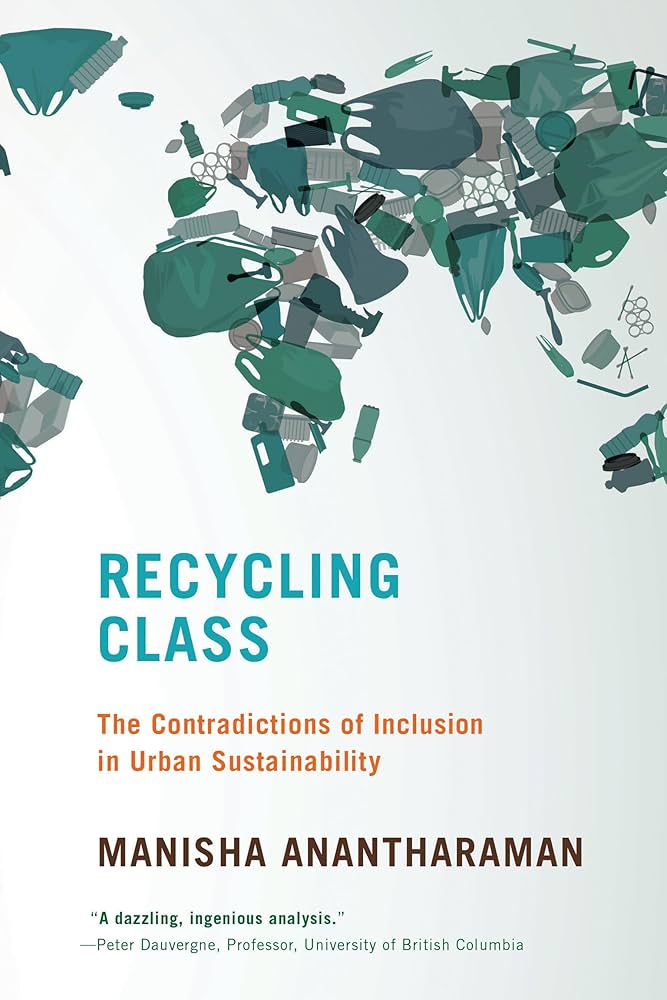
or many advocates of informal waste workers around the world, their formal inclusion into waste management policies and programs, has been the answer to the threat of ongoing and impending dispossession. But should inclusion be the end goal? Since projects of inclusion are often dependent on alliances with middle-class activists, will these alliances always be unstable, and more importantly, highly unequal? Are other, more radical emancipatory political possibilities imaginable? These are just some of the difficult questions that Recycling Class takes head on. Through a detailed ethnographic analysis, this book paints a beautifully nuanced picture of middle-class activism in Bengaluru, and its relationships with waste workers whose labors the alliances crucially depend upon. In doing so, multi-disciplinary scholar Manisha Anantharaman shows us the value of “studying up,” pointing out clearly who should be responsible for systems that “discard well.” In a middle-class world often obsessed with consumption-based activism that hopes to alleviate our “carbon guilt” (Huber 2022), this book’s call for a reparative environmentalism that cannot be achieved without the “annihilation of caste.” This essential intervention has global relevance in the face of rising authoritarianisms, particularly the increasingly violent Hindu nationalism in India.
As a fellow scholar who has also spent over a decade thinking and writing about various aspects of informal economies of waste and recycling in urban India, this book is a remarkable piece of scholarship. Manisha and I embarked on our scholarly journey exploring these issues in two of the largest metropolitan areas in India at the same time; as I was conducting fieldwork in Delhi, Manisha was doing the same in Bengaluru. Post fieldwork, we were analyzing our data, writing, and publishing our work at about the same time. As I read this book, I realized how much richer my own thinking and writing would have been, had I had the chance to engage with Manisha’s work more deeply.
Among the book’s many contributions, one of the most commendable is the rich set of concepts it offers, the “engaged universals” that may have emerged from a particular local context but help us make sense of other places and times. For current and future scholars interested in the politics of urban sustainability, these concepts are a veritable treasure trove. Two sets of concepts would have been particularly helpful for me. The first set—"performative environmentalism” and “communal sustainability”—highlights the collective mobilization of the (middle class) ‘self’ that is simultaneously reliant on and reproduces the exclusions of the ‘other.’ In my work (particularly Luthra (2018) and Luthra (2021)), I tend to emphasize the exclusionary nature of similar formalization projects, overlooking their “performative ontological” potential (Gibson-Graham 2008). The second set—“entrepreneurial environmentalism” and “accumulation by inclusion”—highlights the contradictions in the ways that waste pickers are able to defend their means of subsistence as they are simultaneously subordinated to new forms of exploitation. These concepts speak directly to the issues I was grappling with in Luthra (2020) and Luthra, Lowe and Ochoa Berkeley (2023). In comparison to Anantharaman, my more orthodox materialist approach might miss the effects of these projects that exceed the politico-economic. Recycling Class is an invitation for all scholars to be more ‘intellectually promiscuous,’ reminding us of the power of different ways of seeing.
To celebrate Recycling Class’ intellectual contributions, I am honored to convene this book forum. In what follows, six notable scholars—Sapana Doshi, Pradnya Garud, Vinay Gidwani, David Pellow, Melanie Samson, and Kathleen Stokes--from a range of backgrounds and commitments engage critically with the book while commending its theoretical range and depth, empirical richness and methodological rigor.
References
Gibson-Graham JK (2008) Diverse economies: performative practices for `other worlds’. Progress in Human Geography 32: 613–632.
Huber, M (2022) Climate Change as Class War: Building Socialism on a Warming Planet. London and New York: Verso.
Luthra A (2021) Housewives and maids: The labor of household recycling in urban India. Environment and Planning E: Nature and Space 4(2): 475-498.
Luthra A (2020) Efficiency in waste collection markets: Changing relationships between firms, informal workers, and the state in urban India. Environment and Planning A: Economy and Space 52: 1375–1394
Luthra A (2018) ‘Old habits die hard’: discourses of urban filth in Swachh Bharat Mission and The Ugly Indian. Journal of Multicultural Discourses 13: 120–138.
Luthra A, Lowe J, Ochoa Berkley K (2023) Dispossession by platformization: The rise of on-demand recycling in urban India. Geoforum 141:103731.
Aman Luthra is Assistant Professor of Geography at the George Washington University. His research primarily focuses on the changing landscape of labor and capital in the waste management sector in urban India, with a particular focus on informal workers in this industry. He received his PhD from the Department of Geography and Environmental Engineering at the John Hopkins University in Baltimore, MD in 2015.