
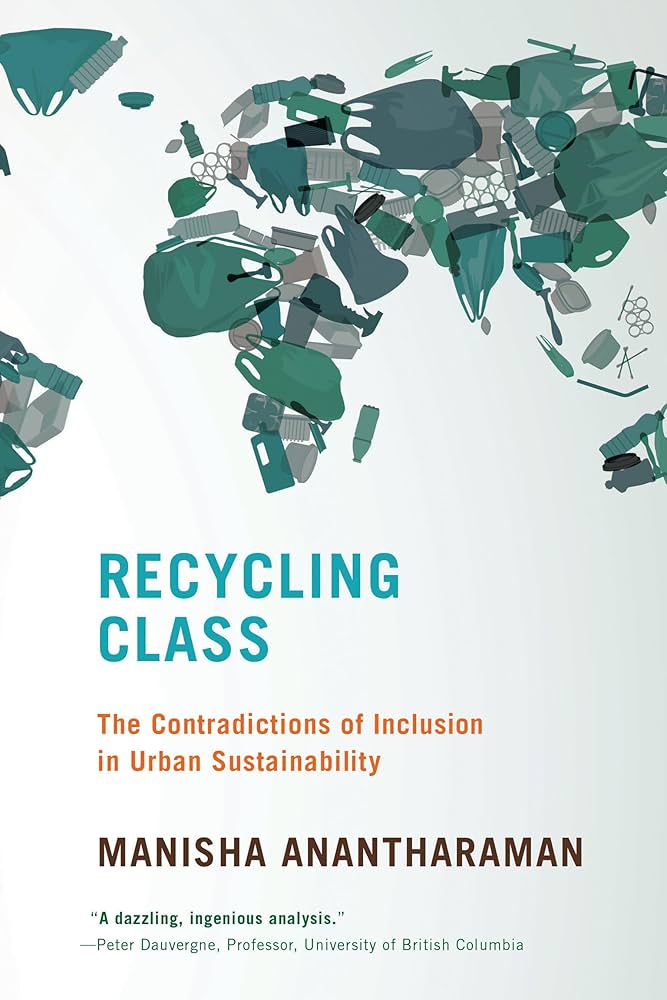



R
ecycling Class attends to the discursive, relational, and material dimensions of Bengaluru’s zero waste movements, sustainability politics, and waste infra-economy. Arguing that “the social and environmental justice implications of community-based sustainability efforts are contingent and contextual – and merit ethnographic examination” (p. 59), the book interrogates the dynamics, contradictions, and implications of community-based approaches to waste and cleaning/greening.
I have struggled to find a way to accurately capture my admiration of this book. I could tell you about how I repeatedly caught myself nodding in agreement with its arguments, or getting lost in its thoughtful and descriptive accounts. But this does not tell you what the book offers, or why it is so compelling. Overall, Recycling Class develops a rich narrative that stitches together the interests, actions, and discourses of a constellation of sustainability and waste work actors across caste, gender, and socio-economic divisions. It is a significant and timely contribution to ongoing discussions of waste infrastructures, governing urban sustainability, and the intersections of labour and environmental justice. Likewise, the book offers an important contribution to ongoing scholarly efforts endeavouring to disrupt hegemonic manifestations of modern environmentalism, by centring laboured and decolonial histories and perspectives within contemporary political imaginaries (Bresnihan and Millner, 2023).
Anantharaman begins by attending to performative, consumer-focused environmentalism, emphasising how actions tend to be based on good intentions yet reinforce biases and privileges that gloss over structural problems. Emphasizing the risks and possibilities of converging interests, the book proceeds to consider the diverse forms of labour that underpin middle-class, women-dominant zero waste communities. Here, Anantharaman introduces the notion of communal sustainability to illustrate the political potential and implications of such efforts. Described as a “contradictory object” (p.167) the reader is encouraged to pay attention to whom is considered part of the community and who speaks for the city’s sustainability. In the case of Bengaluru, middle-class communal sustainability ideals and efforts advocate for more localised and manual forms of waste infrastructural reconfigurations in the form of waste collectives, local collections and recycling centres, and community engagement.
Situating precarious waste labour within broader politics of civic engagement, entrepreneurialism, and the retreat of the state, Recycling Class details the discursive reframing of waste pickers as entrepreneurs as a strategy to mobilise and advocate for inclusion within waste formalization and privatisation schemes. Dry waste collection centres are focused on to illustrate how DIY infrastructural arrangements unfold and emerge out of communal sustainability politics. These flexible and labour-centred infrastructural arrangements push against spectacular, privatised, and modernist ideals for infrastructural development. However, the coproduction processes and labour dynamics associated with these sites ultimately reflect the broader power dynamics and become sites for negotiation and contestation.
Turning to the globalised circular economy investment interests and opportunities in Bengaluru, the book proceeds by illustrating how supposed win-win fallacies are frequently reliant on underpaid or free waste labour, resulting in accumulation by inclusion. Anantharaman concludes by arguing for “reparation by inclusion” through transformative coalitions to reject “the dehumanization of informal workers and the seductions of performative environmentalism” and “reimagine and recreate socio-ecological relations from a full acknowledgement of the injustices of the past as they live into the present” (p.181).
There is little doubt that Recycling Class offers an original and important contribution to ongoing discussions surrounding waste work and infrastructural labour more generally (cf. Luthra, 2020; Fredericks, 2022; Stokes and Lawhon, 2023). In particular, Anantharaman offers a considered politicisation of diverse forms of affective, domestic, and physical labour that coalesce within and through communal sustainability and waste infrastructures. Strategic solidarities are equally an important focus of Recycling Class. Emphasizing how inclusion efforts often enrol “(already oppressed) communities into conducting basic metabolic functions to keep cities functional at lowest cost” (p. 20), the book details how such work frequently reproduces classed, gendered and casted relations. However, Anantharaman emphasizes the dynamic nature of coalitions across class and caste divisions, suggesting they can also be leveraged to make claims and resist.
Drawing upon Fredericks (2018), Samson (2009), Miraftab (2004) amongst others, Recycling Class also does an impeccable job touching upon a variety of ways infrastructure, labour, and citizenship are not only dynamically entwined, but result in discursive and material transformations. For instance, affluent forms of ecological citizenship centred around individual clean and green lifestyles, consumption, and aesthetics contribute to the emergence of community-based infrastructural reconfigurations. Meanwhile, waste picker organisations deploy discourses of public utility and entrepreneurial service provision as opposed to rights-based discourses to advocate for inclusion – emphasizing “what waste pickers could do, as opposed to what they were due” (p.103). There is much to be gained reading this work with citizenship in mind, particularly attending to the ways duties, obligations, responsibilities and rights are both being actively reconfigured as well as emphasized in strategic ways. While superbly covered, I would love to see this line of inquiry developed further by Anantharaman and others, as this seems essential amidst the myriad pressing (and intersecting) challenges surrounding urban governance, infrastructural development, and socio-ecological justice.
More broadly, neoliberal power and logics are an important premise and presence throughout Recycling Class. Just as Anantharaman emphasizes the “contingent, dynamic, and emergent process of infrastructuring” (p. 134), the particular dimensions of neoliberal discourse, actions, and logics are carefully specified throughout the book. Anantharaman recalls how neoliberal imperatives have contributed to the roll-back of state responsibilities surrounding infrastructural development and services, including the proliferation of entrepreneurial, privatised, and community-based waste initiatives. While Recycling Class accounts for the particularities and incorporates a grounded reading of claims and responses, I am interested to learn more about how expectations of the state (and its responses) have evolved amongst the book’s initiatives and actors. In other words, are state-society responsibilities and relations transforming through collective sustainability infrastructures and labour? For instance, how might different logics and dynamics be understood through the lens of ‘actually existing’ neoliberalisms, or when endeavouring to look beyond neoliberalism (Peck, Brenner and Theodore, 2018; Parnell and Robinson, 2013)?
In many ways, Recycling Class responds to Liboiron and Lepawksy’s call for “making new worlds by discarding” (2022, p.144). Without prescribing, Anantharaman offers a nuanced, critical and grounded account of particularities of Bengaluru’s local waste and sustainability politics, emphasizing how alliances can reclaim environmental politics from hegemonic neoliberal interpretations and create possibilities that address and overcome collective injustices. I look forward to engaging with this book more closely in subsequent work, and sharing its insights with students in conversations about infrastructure, labour and livelihoods with urban sustainability.
References
Bresnihan P and Millner N (2023) All We Want Is the Earth: Land, Labour and Movements Beyond Environmentalism. Bristol: Bristol University Press.
Fredericks R (2018) Garbage Citizenship: Vital Infrastructures of Labor in Dakar, Senegal. Durham, NC: Duke University Press.
Fredericks R (2022) Anthropocenic discards: Embodied infrastructures and uncanny exposures at Dakar’s dump. Antipode. Epub ahead of print 13 December 2021. https://doi.org/10.1111/anti.12796.
Liboiron M and Lepawsky J (2022) Discard Studies: Wasting, Systems, and Power. Cambridge, MA: MIT Press.
Luthra A (2020) Housewives and maids: The labor of household recycling in urban India. Environment and Planning E: Nature and Space 4(2): 475-498.
Miraftab F (2004) Making neo-liberal governance: The disempowering work of empowerment. International Planning Studies 9(4): 239–259.
Parnell S and Robinson J (2013) (Re)theorizing cities from the Global South: Looking beyond neoliberalism. Urban Geography 33(4): 593-617.
Peck J, Brenner N and Theodore N (2018) Actually existing neoliberalism. In: Cahill D, Cooper M, Konings M and Primrose D (eds) The Sage Handbook of Neoliberalism. London: Sage, pp.3–15.
Samson M (2009) Wasted citizenship? Reclaimers and the privatised expansion of the public sphere. Africa Development 34(3/4): 1–25.
Stokes K and Lawhon M (2022) What counts as infrastructural labour? Community action as waste work in South Africa. Area Development and Policy 9(1): 24–44.
Kathleen Stokes is an urban geographer and Assistant Professor in the School of History and Geography at Dublin City University. Her research interests include urban governance, infrastructural labour, sustainable cities and urban livelihoods, waste, and vacant space and property.


