



Introduction
R
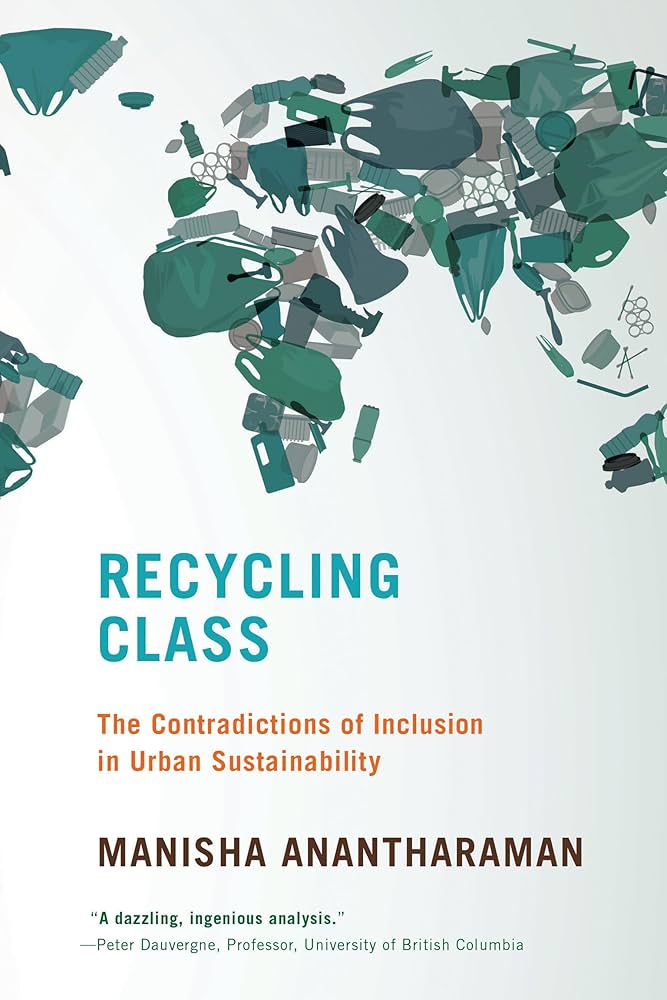
ecycling Class by Manisha Anantharaman is an insightful and timely contribution to scholarship on urban sustainability in postcolonial contexts such as India. The book tells a compelling story of contemporary neoliberal India, where environmentally motivated middle-class actors deploy technocratic, market-based sustainability solutions while relying on deeply exploitative, caste-based waste labour to fulfil their desires for a “clean and green” city. Drawing on long-term ethnographic and community-based research, Anantharaman examines sustainability-driven waste management initiatives led by middle-class residents in response to Bengaluru’s garbage crisis. Using an urban political ecology framework, she situates middle-class environmentalism relationally, revealing the paradox at its core: efforts to integrate waste workers into zero-waste systems simultaneously reproduce caste, class, and gender hierarchies even as they open new avenues for middle-class women’s political participation and for waste workers to claim recognition as indispensable environmental subjects. Through a multifaceted theoretical toolkit, the book challenges dominant sustainability and circular economy discourses that obscure the deeply political—and casteed—nature of environmental governance (Garud 2022a).
Recycling Class is exactly the sort of book we need more of, particularly for its sustained and central engagement with caste. Moving beyond the depoliticized registers of vulnerability and sustainability that dominate mainstream development and environmental discourse, the book situates urban waste management, recycling, and environmentalism squarely within the relations, meanings, and contradictions of caste-based labour and neoliberal capital. In doing so, it avoids two persistent pitfalls in scholarship on South Asia: treating caste as a residual problem to be resolved through inclusive capitalist modernity, and rendering it invisible through the analytic violence of caste-blindness. Building on work that demonstrates how caste logics of purity, pollution, and labour organise urban infrastructures and ecological hierarchies (Ranganathan 2022), Anantharaman locates recycling and environmentalism within the lived and structural contradictions of caste-based labour regimes, rejecting both caste-blind sustainability discourse and liberal fantasies of caste’s erasure.
Crucially, Anantharaman’s politics are not confined to her analytical claims but are enacted through her research practice. The book is grounded in years of careful fieldwork and collaboration with waste-workers’ advocacy groups. In a research landscape shaped by epistemic violence and the objectification of oppressed castes, Anantharaman deliberately directs the analytical gaze upward—towards upper-caste, upper-class urban residents and elite sustainability actors—rather than reproducing extractive modes of studying marginalised communities. We appreciate this commitment to “studying up,” which exposes the unacknowledged casteism embedded within middle-class environmentalist agendas. At the same time, the book foregrounds the embodied ecological knowledge of waste workers and the political efforts of those representing them—forms of expertise routinely dismissed or devalued by circular-economy architects and dominant caste environmentalists. Particularly striking are the author’s deeply personal and vulnerable reflections on her own ongoing efforts to unlearn and decalcify Brahmanism in her embodied beliefs, desires, and practices, adding a level of reflexivity rarely sustained with such honesty.
In this review, we argue that Recycling Class makes a vital intervention by centring caste as a structuring force in urban sustainability politics and by exposing how inclusionary environmental reforms under neoliberal capitalism often function to stabilize, rather than unsettle, relations of caste power. We suggest that bringing the book’s conceptual contributions into dialogue with the work of authors engaged in anti-caste, anti-capitalist praxis allows us to situate its insights within ongoing struggles against casteist capitalism, hegemonic forms of environmental governance, and the narrow horizons of reformist ecological politics.
Performative environmentalism and casteist capitalism
The book’s first major conceptual intervention is performative environmentalism, which Anantharaman develops to describe middle-class eco-lifestyle practices such as recycling, bicycling, and urban gardening. These practices are framed as responsible, community-oriented responses to environmental crisis and are distinct from more overtly exclusionary forms of bourgeois environmentalism that seek to remove the poor from urban space. Performative environmentalism instead emphasises personal responsibility, ethical consumption, and collective neighbourhood action.
Yet, as the book convincingly shows, this ostensibly benevolent environmental subjectivity nonetheless reproduces class and caste distinctions regarding who belongs in environmentalist communities and whose environmental knowledge is recognised as legitimate. Middle-class environmental practices accrue moral authority and public legitimacy, while the need-based ecological practices of the poor remain unrecognised or devalued. As Anantharaman memorably puts it, “power confers green” (Anantharaman 2023: 51).
Here we see both the strength of the analysis and an opportunity for deeper engagement with anti-caste theory. While the book draws on Bourdieu to explain how cultural capital unevenly enables middle-class environmentalists to claim moral authority, this framing can sit uneasily with the author’s otherwise relational approach. Anti-caste scholarship suggests that caste and capitalism cannot be treated as parallel or additive systems. Rather, caste must be understood as an ideologically saturated set of social relations through which capitalism itself is organised in India. To paraphrase Cedric Robinson’s assertion that capitalism is racial capitalism, and drawing on Stuart Hall’s formulation of societies “structured in dominance” (Hall 1996), there is no capitalism in India that can be analytically separated from casteist social relations.
Anti-caste scholars have long shown that capitalist development in India has not displaced caste but has been organised through it. Gail Omvedt’s analysis of agrarian crisis demonstrates how caste relations of production structure surplus extraction in Indian agriculture, systematically channelling value to dominant castes while binding Dalit-Bahujan [1] groups to stigmatised and insecure work (Omvedt 1974). In later work, Omvedt argues that neoliberal globalisation has intensified caste-based dispossession and informalisation rather than producing casteless labour markets (Omvedt 2005). Aloysius similarly rejects the assumption that capitalism or modernity disrupted caste hierarchies, showing instead how caste-based divisions of labour—rooted in regions of agricultural surplus—were consolidated through colonial rule and the modern state, enabling dominant castes to retain control over land, resources, and knowledge (Aloysius 2018). Relatedly, Bedide (Kuffir) demonstrates how a narrow focus on ownership of the means of production obscures the caste configuration of control over capital, labour, and social reproduction, particularly the enduring dominance of Brahmanical elites (Bedide (Kuffir) 2018). Shaikh brings this argument into the urban present, showing that cities—often treated as casteless spaces of industrial modernity—are in fact central sites of casteist capitalism, where Dalit-Bahujan workers are disproportionately concentrated in informal, hazardous, and low-wage labour under conditions of urban industrialisation and neoliberal growth (Shaikh 2021).
Communal sustainability, social reproduction, and Brahmanical patriarchy
Anantharaman’s second major intervention, communal sustainability, examines neighbourhood-based waste governance led largely by middle-class women. Drawing on intersectional feminist theories of social reproduction, the book demonstrates how communal sustainability systematically enrolls women’s labour to replace technocratic infrastructure with affective, relational, and unpaid work.
While middle-class women may experience new forms of empowerment and political engagement, these initiatives depend on extensive uncompensated affective and reproductive labour that extends their roles as household caregivers. At the same time, the heaviest burdens of communal sustainability fall on Dalit women waste workers, whose labour intensifies in order to render “zero-waste” regimes viable.
It would be productive to bring Anantharaman’s discussion into closer conversation with critiques of Brahmanical patriarchy, which foreground how caste reproduction operates through the gendered regulation of sexuality, marriage, and reproductive labour—an insight originally articulated by B.R. Ambedkar’s (Ambedkar 1917) argument that caste is sustained through strict enforcement of endogamy and control over women’s sexuality. Chakravarti further theorised Brahmanical patriarchy as a system in which caste hierarchy is reproduced through the ideological and material subordination of women within family, kinship, and labour arrangements (Chakravarti 1993). As Garud (2022a; 2022b) similarly argues, Brahmanical patriarchy offers a more analytically robust framework than additive intersectionality by insisting on the relational co-constitution of caste, class, and gender. From this perspective, the disciplining of Dalit women’s waste labour and the relegation of savarna [2] women to unpaid care work are not parallel effects of social reproduction but mutually reinforcing mechanisms through which casteist power is reproduced within ostensibly progressive sustainability initiatives.
Entrepreneurial environmentalism and accumulation by inclusion
Anantharaman’s analysis of entrepreneurial environmentalism foregrounds the ways in which waste workers are compelled to market themselves as efficient, green entrepreneurs in order to avoid dispossession. Through the case of Parisara Tanda, a waste-workers’ advocacy organisation, the book shows how alliances with middle-class activists and policy actors enable waste workers to secure tenuous forms of recognition and livelihood protection.At the same time, she argues, participation in “win–win” sustainability schemes intensifies exploitation, surveillance, and control, subjecting waste workers to new regimes of discipline while leaving structural inequalities intact.
Anantharaman conceptualises these contradictory dynamics through accumulation by inclusion, which captures how sustainability initiatives incorporate waste workers in ways that primarily serve capital accumulation rather than justice. Inclusion becomes a mechanism through which environmental governance secures growth, profit, and middle-class ecological aspirations while reproducing caste and class oppression (Anantharaman 2023: 169). These dynamics echo broader patterns observed in neoliberal urban redevelopment and environmental governance (Doshi 2019). The author argues in her conclusion for reparations as an alternative to accumulation by inclusion which we engage in our remarks below.
Anti-caste praxis, reparations and beyond
The book’s concluding call for reparations—drawing inspiration from Black radical and abolitionist traditions—raises important questions about pathways towards environmental justice. While we appreciate this provocation, we remain sceptical of the political viability of reparations frameworks in India when mobilisation depends primarily on alliances with caste-privileged middle classes who often refuse to acknowledge caste altogether.
Anti-caste history suggests an alternative path grounded in horizontal solidarity and independent political power. Thinkers and organisers such as Kanshi Ram, following the legacy of Jyotirao and Savitribai Phule, reimagined Dalit–Bahujan politics as a project of majority power rather than minority recognition (see Ilaiah 2012). By conceptualising Bahujans as the working-class majority and centring those labouring in the informal economy—now over 90 per cent of India’s workforce—anti-caste praxis offers a vision of social, economic, and environmental democracy rooted in collective power rather than elite inclusion.
We have chosen to foreground anti-caste theory and praxis emerging from Dalit–Bahujan social mobilisation in order to situate Recycling Class within intellectual traditions that remain under-engaged in much of the field. This relative absence reflects longer histories of colonial and Brahmanical knowledge production that have tended to marginalise anti-caste scholarship, particularly work rooted in struggles against casteist capitalism and environmental casteism. Recycling Class does not resolve all of these tensions, but it takes meaningful and commendable steps along what the author herself describes as a lifelong process of unlearning. Our engagement with the book is offered in a spirit of solidarity with that journey—one that is necessarily collective, contested, and ongoing.
[1] The term Dalit-Bahujan refers to the working-class majority in India which comprises the ex-untouchables and the historically oppressed lower caste groups.
[2] The term savarna refers to Brahmins and other upper castes who make up the ruling minority in India.
References
Aloysius G (2018) British created Hinduism and Brahmins created the myth that India is Bharat. Prabuddha: Journal of Social Equality 2(1). Available at: https://prabuddha.us/index.php/pjse/article/view/28/20
Ambedkar BR (1917) Castes in India: Their mechanism, genesis and development. Indian Antiquary 46: 81–95. Available at: https://franpritchett.com/00ambedkar/txt_ambedkar_castes.html
Anantharaman M (2023) Recycling class: The contradictions of inclusion in urban sustainability. Cambridge, MA: MIT Press.
Bedide N (Kuffir) (2018) The Brahmin keeps India in the 18th century. Prabuddha: Journal of Social Equality 2(1). Available at: http://prabuddha.us/index.php/pjse/article/view/30/22
Chakravarti U (1993) Conceptualizing Brahmanical patriarchy in early India: Gender, caste, class and the state. Economic and Political Weekly 28(14): 579–585.
Doshi S (2019) Greening displacement, displacing green: Environmental subjectivity, slum clearance and the embodied political ecologies of dispossession in Mumbai. International Journal of Urban and Regional Research 43(1): 112–132.
Garud P (2022a) Environmentalism, labour and the history of food production in Mumbai. Prabuddha: Journal of Social Equality 6(2). Available at: https://prabuddha.us/index.php/pjse/issue/view/7
Garud P (2022b) Rethinking urban agriculture: Environmental casteism, subjectivity and the labour politics of food production in Mumbai. PhD dissertation, University of Arizona, Tucson, AZ.
Hall S (1996) Race, articulation, and societies structured in dominance. In: Baker HA Jr, Diawara M and Lindeborg RH (eds) Black British cultural studies: A reader. Chicago, IL: University of Chicago Press, 16–60.
Ilaiah K (2012) A paradigm shift called Kanshi Ram. Round Table India, 15 March. Available at: https://www.roundtableindia.co.in/a-paradigm-shift-called-kanshi-ram/
Omvedt G (1974) Agrarian crisis in India. Bulletin of Concerned Asian Scholars 6(4): 17–23. https://doi.org/10.1080/14672715.1974.10413002
Omvedt G (2005) Capitalism and globalisation, Dalits and Adivasis. Economic and Political Weekly 40(47): 4881–4885.
Ranganathan M (2022) Toward an urban political ecology of caste. Urban Geography 43(1): 135–143.
Shaikh A (2021) Outcaste Bombay: City making and the politics of the poor. Seattle, WA: University of Washington Press.
Sapana Doshi is Associate Professor of Critical Race and Ethnic Studies at the University of California, Merced. She has published on urban, environmental, and body politics in journals such as Antipode; Annals of the American Association of Geographers; International Journal of Urban and Regional Research; and Geopolitics. Her recent book, Corruption Plots: Stories, Ethics, and Publics of the Late Capitalist City (Cornell University Press, 2023), co-authored with Malini Ranganathan and David Pike, was awarded the Anthony Leeds Prize in Urban Anthropology by the American Anthropological Association. Sapana earned her PhD in Geography from University of California, Berkeley.
Pradnya Garud is an independent researcher who writes about caste, labor, and environment. She works in the area of environmental health policy and is a 2024 Agents of Change in Environmental Justice fellow. Pradnya completed her Ph.D. in geography from University of Arizona, and her dissertation research explored issues of caste-based and gendered labor in urban agriculture and food production. Her research interests include social movements, political ecology, climate and environmental justice.


