



N
icholas Georgescu-Roegen’s (1971: 10) landmark book The Entropy Law and the Economic Process begins with the fundamental premise that “the material basis of life is an entropic process,” which is to say that “any life-bearing structure maintains itself in a quasi-steady state by sucking low entropy from the environment and transforming it into higher entropy. Reproaching the “mechanistic sin” of economics, Georgescu-Roegen contends that an economic process based on the qualitative transformation of available energy (for example, fossil fuels) into a dissipated form where that free energy is now bound and unavailable is evidence of the capitalist economy’s fundamental unsustainability. Employing the vocabulary of thermodynamics, Georgescu-Roegen calls high entropy forms “waste” and deems the transformation of low entropy into high entropy an “irrevocable” process (Georgescu-Roegen, 1971: 18). His blunt prognosis? “The faster the economic process goes, the faster the noxious waste accumulates. For the earth as a whole there is no disposal process of waste. Baneful waste once produced is there to stay, unless we use some free energy to dispose of it in some way or another” (Georgescu-Roegen, 1971: 305, my italics).
There lies the nub of the matter. With the rise of urban planning, city governments were tasked by municipal charters to dispose of (initially) sanitary waste and later, with mass consumption, post-consumer waste. Garbage was city “property” but long viewed by city authorities as an anti-commodity that required money and energy to manage and reaped no benefits. Over the decades, growing populations of waste pickers around the world, particularly in cities of the global South, have demonstrated that with the application of labor power – the embodied capacity for physical and mental toil, cognitive work, and discernment – the material constituents of garbage, amorphous matter that would tend toward high entropy forms, can be segregated and recuperated into lower entropy forms with use and exchange value to subtend semi-autonomous livelihoods. As several waste and discard studies scholars have noted, over the past two decades city authorities and private corporations have belatedly come to recognize garbage as a resource that can yield revenue and profit, whether as feedstock for waste-to-energy plants or as a reservoir of recoverable materials. Both masquerade as alibis for ‘green capitalism’ (a prospect gracefully punctured by Jesse Goldstein in his 2018 book, Planetary Improvement). And whether publicly acknowledged by advocates of “market-based” solutions or not, it is the prowess of informal sector waste collectors in recycling and repurposing postconsumer detritus that has furnished proof-of-concept for the material recovery pathway.
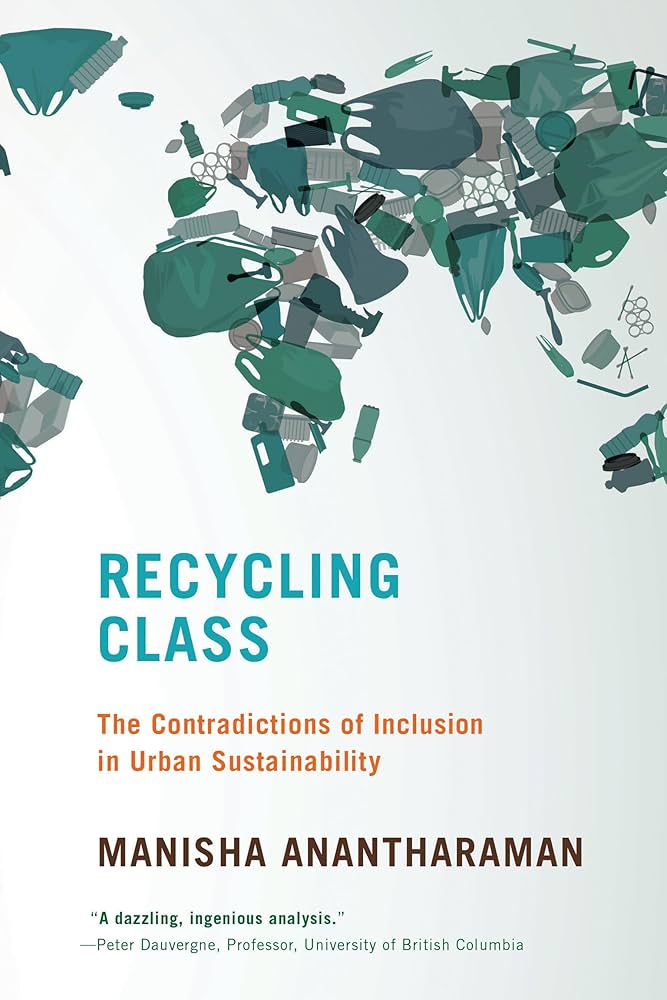
Manisha Anantharaman’s splendid book delivers another dent in the armor of “green capitalism”. But it does much more. While recent monographs (Millar (2018), O’Hare (2022) and Butt (2023), to name but three ethnographic exemplars) have deepened our understanding and appreciation of the workers and petty entrepreneurs who underwrite urban informal waste economies in cities of the global South, by electing to “study up” Anantharaman fills a conspicuous gap in the literature around middle class residents who are the primary generators of urban waste.
Based on participant research with a Care Collective, a woman-dominated, middle-class, zero-waste neighborhood group; the Clean and Green Forum (TCGF), a citywide waste management advocacy network; and Parisara Tanda, a waste-picker organization that works with middle-class allies, Recycling Class sharply illuminates changing middle-class attitudes toward waste; the rise of middle-class practices that diverge from knee-jerk NIMBYism or “bourgeois environmentalism;” and the surprising coalitions that can arise between middle class, dominant caste urban residents and workers from socially marginalized communities whose livelihoods depend on access to recyclables. Anantharaman emerges as a sensitive ethnographer, able to spot contradictions in the “performative environmentalism” of Bengaluru’s cultural elite (Chap. 1) and in neighborhood-based waste management initiatives that she conceptualizes as forms of “communal sustainability” (Chap. 2). She is acutely attuned to her interlocutors’ (sometimes tacit) caste prejudices, but never scoffs at their intentions. She explains the fallacies and fantasies of urban sustainability programs, but remains open to the promise – indeed, recognizes the importance – of cross-class, inter-caste alliances in producing “just environments”. She understands that recycling sustains waste-picker livelihoods but also that it is not a panacea for rampant consumerism. Recycling generates the illusion of progress without confronting the steep environmental costs of manufacturing the goods we use and discard (MacBride, 2011; Lepawsky, 2018). She recognizes why waste-pickers must re-present themselves as entrepreneurial ‘environmentalists’ who subsidize cities by their infrastructural labor (Chap. 3) but knows how such a framing risks cooptation by a ‘green capitalism’ discourse that dangles the promise of technical and market solutions for capitalism’s ailments (Chap. 5) without questioning its accumulation death-drive, its substrate of “cheap natures”, and its racial hierarchies (Patel and Moore, 2018; Hickel, 2020). She entertains the promise of DIY “infrastructuring” (Chap. 4), but also underscores the “scalar mismatch” and bureaucratic apathy that hobbles the efficacy of such initiatives.
Anantharaman grasps that any durable aspiration for urban sustainability must embrace ‘de-growth’ rather than visions of a ‘circular economy’, where all waste is recuperated, all material loops are closed, and all products are recycled indefinitely – a prospect that is “in any practical sense, impossible … because even cyclical systems consume resources and create wastes and emissions” (Corvellec, Stowell and Johansson, 2021: 3). Or, as Cullen (2017: 483) observes, echoing Georgescu-Roegen: “Every loop around the circle creates dissipation and entropy, attributed to losses in quantity (physical material losses, by-products) and quality (mixing, downgrading). New materials and energy must be injected into any circular material loop, to overcome these dissipative losses.”
There is so much to commend in Anantharaman’s book: deep clarity of thought, rich empirical insights, a veritable trove of mid-range concepts that can travel, and a narrative that never ceases to engage. Still, I do have questions.
Does the cosmopolitanism of Bengaluru’s middle classes mean that those alliances and forms of infrastructuring are not modular? For instance, the examples of middle-class attitudes to waste management in cities like Ahmedabad (Wittmer, 2020), Chennai (H. Anantharaman, 2019), or Delhi (Luthra, 2020; Kornberg, 2024) suggest alternative trajectories and limited possibilities for building cross-class, inter-caste coalitions. Here, geographic variation in the workings of caste as a dispositif of material, cognitive, and sensory practices that differentiate bodies as more or less burdened with the stigma of pollution seems salient and worthy of further investigation.
As Anantharaman notes, she chose to “study up”. One outcome of this is that readers get a keen sense of the ways in which caste biases manifest in the practices of middle-class individuals like Kranthi or Swamy, but a somewhat impoverished understanding of SC/ST waste workers’ own experiences of being casted in the “contact zones” of interaction with dominant caste allies and residents. Similarly, while the social reproductive demands of “communal sustainability” and “DIY infrastructures” on middle-class women who spearhead zero-waste initiatives is stark, the social reproductive toll on waste workers is less so.
In the same vein, Anantharaman at one point writes how in Bengaluru, “caste compounds and amplifies coloniality” (p. 124), but without elaborating. Here, the off and on equation of racial capitalism and caste capitalism becomes a concern; and I found myself wishing that Anantharaman has leveraged her fierce analytical skills to parse the logics of race and caste more deliberately and insistently.
But these are minor quibbles with an otherwise extraordinary book that serves as a model of engaged, ethical, and intellectually abundant scholarship.
References
Anantharaman H (2019) Neo-liberalising inclusion? Economic and Political Weekly 54(47): 61-67.
Butt W (2023) Life Beyond Waste: Work and Infrastructure in Urban Pakistan. Palo Alto: Stanford University Press.
Corvellec H, Hultman J, Jerneck A, Arvisdon S, Ekroos J, Wahlberg N and Luke TW (2021) Resourcification: A non-essentialist theory of resources for sustainable development. Sustainable Development 29(6): 1249-1256.
Cullen JM (2017) Circular economy: Theoretical benchmark or perpetual motion machine? Journal of Industrial Ecology 21(3): 483-486.
Georgescu-Roegen N (1971) The Entropy Law and the Economic Process. Harvard University Press.
Goldstein J (2018) Planetary Improvement: Cleantech Entrepreneurship and the Contradictions of Green Capitalism. Cambridge, MA: MIT Press.
Hickel J (2020) Less is More: How Degrowth Will Save the World. New York: William Heinemann.
Kornberg D (2024) Transactional pathways: Institutional possibilities for status and wealth under racial/caste capitalism. Current Sociology 73(2): 228-246.
Lepawksy J (2018) Reassembling Rubbish: Worlding Electronic Waste. Cambridge, MA: MIT Press.
Luthra A (2020) Housewives and maids: The labor of household recycling in urban India. Environment and Planning E: Nature and Space 4(2): 475-498.
MacBride S (2011) Recycling Reconsidered: The Present Failure and Future Promise of Environmental Action in the United States. Cambridge, MA: MIT Press.
Millar K (2018) Reclaiming the Discarded: Life and Labor on Rio’s Garbage Dump. Durham: Duke University Press.
O’Hare P (2022) Rubbish Belongs to the Poor: Hygienic Enclosure and the Waste Commons. London: Pluto Press.
Patel R and Moore JW (2018) A History of the World in Seven Cheap Things. London: Verso.
Wittmer J (2022) Dirty work in the clean city: An embodied urban political ecology of women informal recyclers’ work in the ‘clean city’. Environment and Planning E: Nature and Space 6(2): 1343-1365.
Vinay Gidwani is Professor and Chair, Department of Geography, Environment, and Society, University of Minnesota, Twin Cities, USA. Gidwani is an economic and labour geographer who studies agrarian transformations, migration, and urban informal work. His forthcoming book, Chronicles of a Global City: Speculative Lives and Unsettled Futures in Bengaluru (University of Minnesota Press) is co-edited with Michael Goldman and Carol Upadhya.


