



I
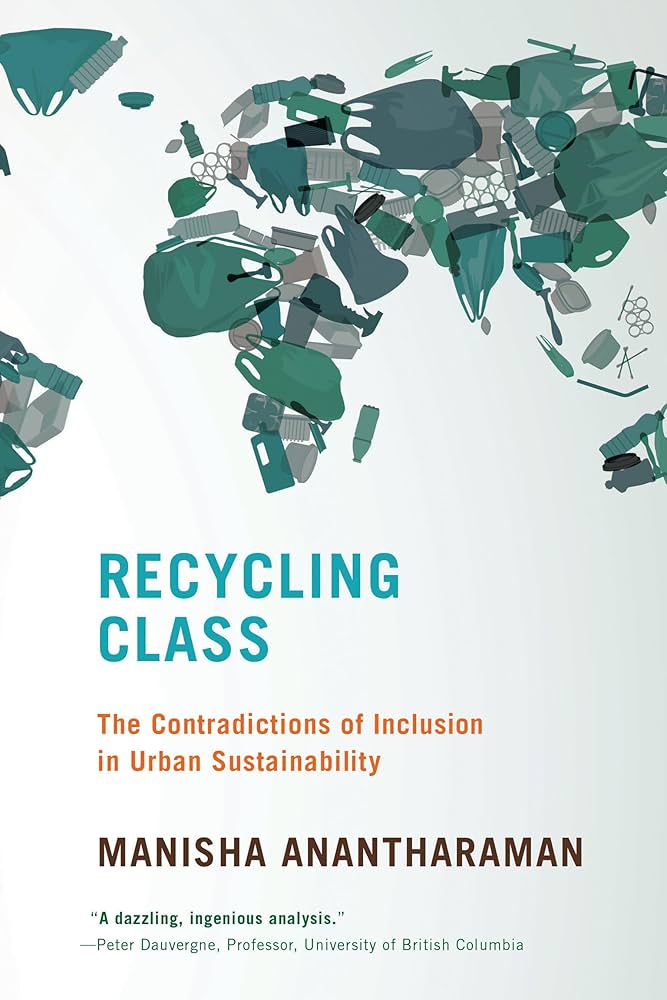
n Recycling Class: The Contradictions of Inclusion in Urban Sustainability, Manisha Anantharaman conducts nuanced, ethnographic analysis of upper-caste, middle-class initiated zero waste initiatives in Bengalaru, India, to provide insight into a number of pressing environmental questions - What should sustainability mean? How do existing, intersectional social relations of class, caste, gender, and race undermine even well-intentioned middle-class sustainability initiatives? And what kinds of coalitions can advance the achievement of environmental, social, and economic justice?
Recycling Class is able to contribute to all of these debates due to Anantharaman’s development of a rigorous methodology to study urban sustainability. Anantharaman argues that to reclaim environmental questions from technocratic, managerial, and economistic capture, we need a methodological approach that is relational, historical, and spatial (p. 178). Eschewing top-down understandings of governmentality, she sees power as diffuse and so utilizes ethnographic methods to illuminate the contested processes through which the low-tech, neighbourhood-based ‘communal sustainability’ initiatives she analyzes were constituted. Doing so simultaneously reveals why the specific form assumed by these initiatives, which opened space for waste pickers, remains unstable and open to further transformation in both more emancipatory and reactionary directions, a key political pre-occupation of the book.
In developing her analysis, Anantharaman teases out the numerous forces at multiple scales that shape the initiatives she studies. I was particularly appreciative of her discussions of how Bengalaru’s history of resident involvement in urban improvement helps to explain middle-class activists’ commitment to communal sustainability, as well as how Bengalaru’s urban identity as a start-up city informed the strategic decision by Parisara Tanda (PT), an NGO that advocates for waste pickers, to adopt an entrepreneurial framing of waste pickers. At the same time, Anantharaman expands her gaze far beyond the local to provide grounded analysis of how neoliberal capitalism, national waste policy, global waste and urban policy agendas, the shift to green capitalism, circular economy discourses, waste pickers’ struggles in other parts of India and around the world, caste, patriarchy, and a number of other relevant structures and processes emanating from larger scales were rendered internal to and shaped, but did not determine outcomes in Bengalaru. Because of this, Recycling Class succeeds in its effort to generate concepts that serve as “engaged universals” developed through analysis of specific initiatives in Bengalaru but nevertheless able to help make sense of other places (p. 166).
For me, Recycling Class is a wonderful example of what ethnographic analysis rooted in an understanding of the production of space (Lefebvre, 1974), or what Gillian Hart conceptualizes as ‘critical ethnography’ (Hart, 2006), can contribute to the development of concepts adequate to critically interrogate “urban sustainability”. Given the book’s explicitly spatial approach to analysis and the many commonalities with critical ethnography, I was surprised that neither Lefebvre nor Hart is referenced. In the interest of gaining deeper insight into Anantharaman’s methodology, I am keen to know more about how she distinguishes her approach from theirs.
Anantharaman’s conceptualization of communal sustainability as a “contact zone” is perhaps the book’s most significant contribution to strategic debates on environmental praxis. The contact zone emerged as the upper caste middle-class zero-waste activists’ sustainability projects relied on waste pickers’ caste, class, and gender-based labor. However, in keeping with her relational approach and conceptualization of power, Anantharaman highlights that contact zones always involve contradictory aspects and can be contested (p. 175). Based on the deep knowledge and skills that waste pickers develop through their intimate contact with waste, and hence their crucial role in the city’s urban metabolism, PT and waste pickers were able to transform the contact zone into a site for negotiation. In the context of caste prejudice and ‘environmental casteism’ that fuelled middle class activists’ desire to distance themselves from both waste and waste pickers, it was waste pickers’ contact with waste that enabled them to shift how the middle class perceived and related to them. While ruefully observing that zero-waste activists remained wedded to a ‘performative environmentalism’ that cemented, rather than fundamentally transformed caste and class relations, Anantharaman remains hopeful that “it is through “contact”, occurring in this case through the material, metabolic bonds of garbage, that sustainability can be reclaimed as a progressive discourse that informs action on the ground” (p. 11).
Anantharaman builds from this analysis to intervene in debates on the growing trend to officially incorporate waste pickers into ‘circular economy’ initiatives. She argues that while this is presented as “win-win” situation, it is a “Trojan horse for capitalist gain” (p. 22) that “emerges out of the realization that waste pickers are the cheapest available option” (p. 158), prioritizes economic growth and corporate profit, reduces waste picker autonomy, and simply repackages exploitative and dehumanizing relations to make them more palatable (p. 23, p. 146). Playing on Harvey’s concept of “accumulation by dispossession” (Harvey, 2005), Anantharaman calls this “accumulation by inclusion”, which she argues will neither end waste pickers’ exploitation nor achieve true sustainability.
Expanding on her earlier work with Jennifer Tucker (Tucker and Anantharaman, 2020), Anantharaman concludes Recycling Class by arguing for “an alternative agenda of reparation by inclusion, which rejects the dehumanization of informal workers”, and “seeks to reimagine and recreate socio-ecological relations from a full acknowledgement of the injustices of the past as they live in the present” (p. 181). Rooted in recognition that informal workers have long subsidized capital accumulation, reparation by inclusion would redistribute resources, power, and decision-making to waste pickers (p. 182-3). Anantharaman argues that “[e]nacting reparation by inclusion will require…mutual vulnerability through transformative coalitions” (p. 25) in which “privileged environmentalists, scholars, and activists must accept leadership from waste pickers, sanitation workers, and other frontline communities, and prioritize social reform and reparation over aesthetics or efficiency” (p. 183). It is only through such coalitions, which must also confront throwaway culture, commit to degrowth, support the abolishment of caste, and reject dehumanization (p. 165-7, p. 180-2), that “sustainability can become a terrain through which ecological and social harm can be repaired” (p. 182).
I am in full agreement with these goals and the argument that such fundamental transformations in social relations are central to reclaiming sustainability. However, ending Recycling Class in this way begs the question of how such coalitions can be achieved, particularly as the book emphasizes that the coalition underpinning communal sustainability in Bengalaru maintained, rather than transformed, existing caste and class relations. While Recycling Class does not provide a clear answer to this question, I argue that a more thorough development and implementation of the book’s methodology could assist in doing so. In concluding this review, I identify three key areas that I hope Anantharaman and others will elaborate in future work so as to better inform the development of truly transformative environmental praxis in urban sustainability contact zones.
First, if we want to understand why caste and class relations did not change in Bengalaru (and therefore gain insight into what would need to be done differently in the future), we need to know more about whether and how these issues were explicitly raised and engaged, something which is not clear in the book. This would require a more processual approach to relational analysis, including ethnographic accounts of encounters between waste pickers and residents, as well as their critical reflections on these interactions, such as in Carlos Forment’s rich accounts of waste picker-resident engagements in Buenos Aires’ Neighbourhood Assemblies (Forment, 2019). Because residents are not homogenous and have different political commitments and orientations towards waste pickers (Samson et al., 2022), it would also be helpful to learn more about debates between residents, how the conservative hegemonic position was established, and whether there are potential resident allies who would work in solidarity with waste pickers for more radical transformation of social relations.
This raises the second, related issue of the need for a greater focus on waste pickers as political strategists (Carbonai, Checchi and Lentz, 2023; Samson, 2025). Anantharaman states that she chose not to interview waste pickers for the book as she wanted to study-up and focus on upper-caste, middle-class activists and amplify existing public statements by waste pickers (p. 83). But waste pickers and organizations that work with them rarely make public statements about their own internal political debates, strategizing processes, and post-mortems of their actions. Comprehensive relational analysis of the resident-initiated contact zone is significantly limited by the absence of waste pickers’ perspectives – waste pickers must be engaged as epistemic agents as part of “studying-up”. Doing so would also enable us to learn from initiatives Anantharaman too categorically dismisses as ‘accumulation by inclusion’ – while this may be capital’s agenda, there are also examples of waste picker organizations carefully engaging in these processes as part of broader strategies to redress racial capitalism that advance the type of reparations Anantharaman advocates (Samson, 2025).
In addition, many of the public statements re-presented in Recycling Class were made by PT staff members, not waste pickers. There is significant slippage in the book between the description of strategies and positions as belonging to waste pickers and as belonging to PT. While PT is aligned to and advocates for waste pickers, it is an NGO, not a democratic waste picker organization (p. 95-6). Given Anantharaman’s call for waste picker leadership of transformative coalitions, it is important that we gain deeper insight into how PT’s strategies were developed, how waste pickers were involved in these processes, the power relations between NGO staff and waste pickers, and internal debates amongst waste pickers and between waste pickers and PT staff over how to engage upper-caste, middle-class activists and the state. I am interested to know whether the new mass-based organization that was forming as the period covered by the book drew to a close (p. 177) has maintained an approach of strategic essentialism and whether it is pursuing any strategies Anantharaman believes are advancing reparations.
Finally, while ‘reparation by inclusion’ is a nice play on ‘accumulation by inclusion’, inclusion is a profoundly liberal concept focused on incorporation into something that already exists. This terminology seems to run counter to both Anantharaman’s relational approach and her focus on what upper-caste, middle-class activists must do differently to move beyond ‘performative environmentalism.’ Building from Anantharaman’s own analysis, I wonder if the concept “reparative environmentalism,” which appears in passing on page 178, could be more productively elaborated to capture her reparative agenda, critically interrogate the power relations in existing sustainability initiatives, and inform strategic analysis of what must be done to create coalitions rooted in mutual vulnerability that advance environmental, economic, and social justice.
References
Carbonai D, Checchi M, and Lentz L Jr (2023) Resistant recycling and recycling collective subjectivations of waste pickers in Rio Grande Do. Environment and Planning C: Politics and Space 41(4): 808–25.
Forment CA (2019) From populations to plebeians in the Global South: Buenos Aires’ waste pickers. Constellations 26: 554–68.
Hart G (2006) Denaturalizing dispossession: Critical ethnography in the age of resurgent imperialism. Antipode 38(5): 977–1004.
Harvey D (2005) The New Imperialism. Oxford: Oxford University Press.
Lefebvre H (1974) The Production of Space. Oxford: Blackwell.
Samson M (2025) Not at our disposal: Reclaimer’s critique of disposability capitalism. In: Corvellec H (ed) Waste as a Critique. Oxford: Oxford University Press, pp.216-239.
Samson M, Kadyamadare G, Ndlovu L and Kalina M (2022) ‘Wasters, agnostics, enforcers, competitors, and community integrators’: Reclaimers, S@S, and the five types of residents in Johannesburg, South Africa. World Development 150(February): 105733.
Tucker JL and Anantharaman M (2020) Informal work and sustainable cities: From formalization to reparation. One Earth 3(3): 290–299.
Melanie Samson is an Associate Professor of Sociology at the University of Johannesburg. She facilitated the participatory process to develop national government’s Waste Picker Integration Guideline for South Africa and is the primary author of the Guideline. She is completing the manuscript for her book Beyond Disposability: Revitalizing Labor, Value and Struggle on a Soweto Garbage Dump.


